
Define Your Scope, Manage Your Impact
You don’t need a new department for managing your impact. You need a new mindset and lens. Let’s normalise managing for social value; not just profit.

Impact Without Extra Work
You don’t need a new department. You need a new mindset and lens.
When most people hear “impact management,” they think of paperwork, complex metrics, maybe even a whole new department. Impact should not be separate from business-as-usual, as it risks being peripheral, under-resourced, and performative.
You’re already doing work that affects people and the planet.
The question isn’t if you have impact, it’s what part of that change and outcome you’re actually responsible for, and whether you’re managing it intentionally.
So how do you build impact into your business without adding more to your plate?
Let’s break it down.
3 Ways to Manage Impact Using What You Already Have
1. Look at your value chain
Think about your day-to-day business decisions:
Who do you hire?
Who do you buy from?
How are your products or services used?
👉 This is how you set the scope of your impact—what you focus on, and where you aim to make a difference.
Without this, you’ll end up trying to measure too much—or miss what really matters.
2. Use tools you already have
You don’t need new software to get started.
Your Customer Relationship Management (CRM)? Add a field to track who you're reaching.
Your finance sheet? Annotate social or environmental goals alongside cost and revenue.
👉 Hint: this is how you start capturing your baseline, thresholds, and targets.
Visibility is the first step toward accountability.
3. Make it a habit, not a project
Rather than treating impact as a quarterly report or a one-off review, try making it part of your regular workflow.
In your next team meeting, ask:
“What’s already changing? For whom? And is that change good enough?”
This small shift in conversation turns impact from a side project into a daily mindset.
Just Think Differently
Impact isn’t something you add on top of everything else.
It’s how you do what you already do; with clarity, with intention, and with better questions.
So instead of asking:
“What should we add?”
Start asking:
“What’s already changing? For whom? And is that change good enough, and within our scope?”
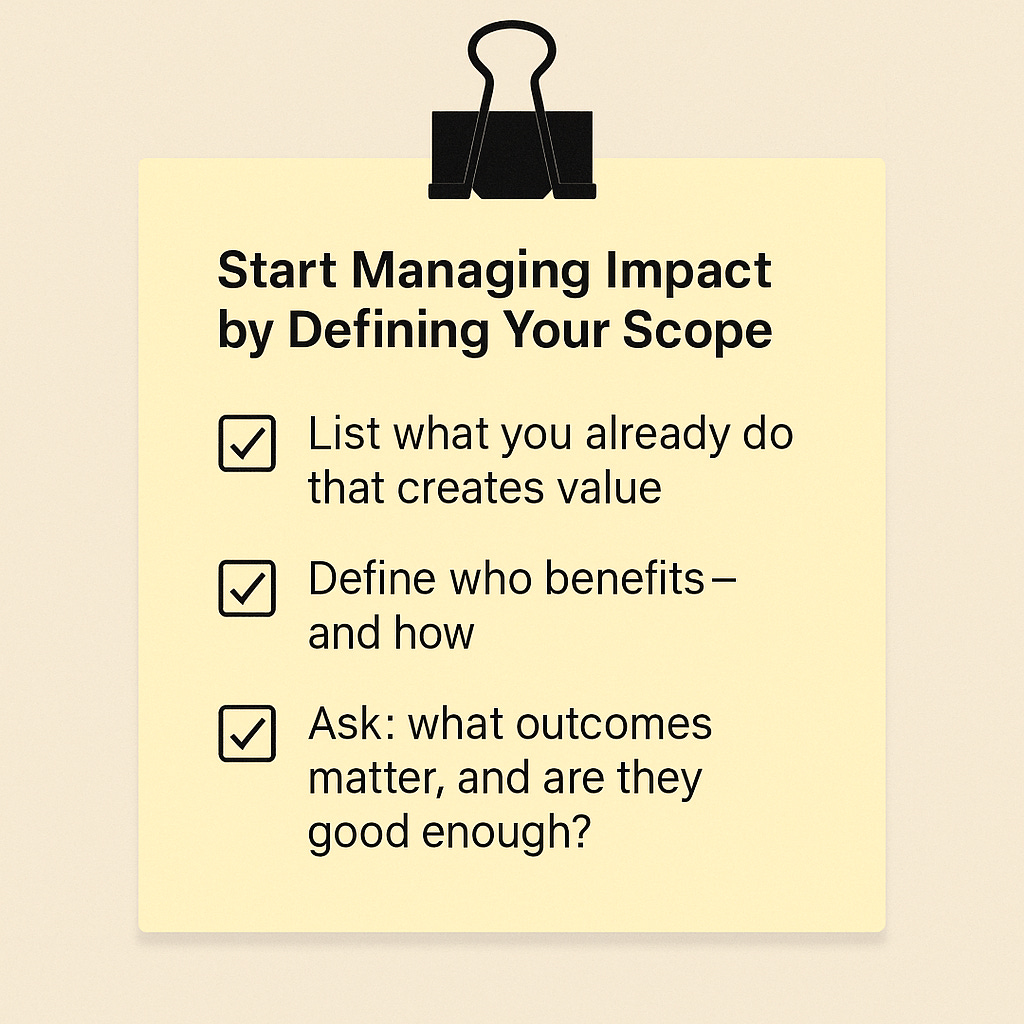
👀 Impact Tip
Want to track progress without fancy tools? Try this:
List a few things you already do that benefit others. Choose one to start with
Write down who benefits and how.
Ask: what’s a “good enough” result, and are we there yet?
That’s your starting point. From there, you can build, adjust, and improve.
If this post helped reframe how you think about impact, share it with someone else who’s navigating the same journey. Let’s normalise managing for value; not just profit.